
Deadline (application) :
December 17th, 2026 at 16:00 (EST)
Announcement of results :
Spring 2027
Start year of grant :
2027-2028
Amount :
$ 75,000
Duration :
18 months

Partnership
V1Studio-Axelys-Mitacs
*The French title is used in both languages
An informational webinar will be held on November 18, 2026 from 12 p.m. to 1 p.m. EST. Click here to register (registration is mandatory). Once available, the webinar recording will be added to the toolbox.
Applications must be submitted through the “Espace demande” section of the FRQnet portal, the transaction interface used by the FRQ for submitting funding applications and managing awards. Once in the portal, you will find the application form by clicking the “Préparer une nouvelle demande de financement” button at the top of the page.
If you are an established researcher or a university interested in hosting a scientist who is starting a company, contact the CESI team to learn about the requirements for university hosting.
In addition to these program rules, applicants are responsible for familiarizing themselves with the Common General Rules (CGR), which apply to all FRQ programs (French only). Where specific conditions apply to this program, they are indicated on this page and take precedence over the CGR.
This program is part of the FRQ’s initiatives to recognize the diversity of knowledge and research contributions (E3R/CoARA).
1. CONTEXT
1.1 Science entrepreneurship in Quebec
Science-based companies are built on leveraging the results of public research and the scientific expertise of their teams. They rely on enhanced research and development capacity (many have a laboratory, test benches or prototyping facilities) as well as highly diverse networks that enable them to conceive bold projects and make strategic pivots to address emerging needs.
These companies are therefore very agile, and many of them become essential to building a strong innovation ecosystem in Quebec and to showcasing promising sectors here and internationally, both as cutting-edge technology companies and as companies with social and environmental impact.
1.2 Support for the transition from research to entrepreneurship
The transition from academia to entrepreneurship means stepping out of one’s comfort zone and facing new uncertainties as well as a new culture. The support ecosystem is complex to navigate when looking for support specifically for researchers with research-based innovations. Support programs tend to focus on developing the business project and less on the entrepreneurial mindset of the person leading it. The reality is that entrepreneurship requires a set of professional skills that differ from, though complement, those of academia, and calls for quickly connecting with the key players specific to the company’s sector. Nevertheless, the development of research-based innovation can benefit greatly from a university connection and from access to resources dedicated to advancing the most up-to-date knowledge. The result is a distinct entrepreneurial pathway that combines support in a new career path, the development of research-driven innovation, and the building of a network that bridges academia, industry, and other sectors.
1.3 Partners joining forces
The FRQ, Mitacs, V1 Studio and Axelys have partnered to offer a pathway specifically designed to support PhD holders who want to start a company, whatever the reason and route that leads them to entrepreneurship (for details on the partners, see section 10). By submitting a single application, candidates obtain support for their transition to entrepreneurship, with the possibility of complementary funding and support focused on the individual as much as on the business solution. In doing so, the company builds long-term university ties as well as a network with non-academic stakeholders.
2. PROGRAM OBJECTIVES
2.1 The objectives of the program are:
For the candidate:
- Funding and support to focus on their business project;
- A clear pathway that facilitates their connection with a university host institution and an established researcher who supports them in turning their research project into a science-based, innovative company;
- Personal development.
For the ecosystem:
- Help universities complement their existing services for PhD holders interested in entrepreneurship;
- Address cultural barriers in order to leverage the university connection as a springboard for creating science-based, innovative companies;
- Foster the transfer of research results to society;
- Promote science entrepreneurship.
2.2 The science entrepreneurship pathway and the profile sought for the CESI program
The program aims to support candidates who are already well along their science entrepreneurship journey and who wish to create or develop their science-based company around a project that requires research.
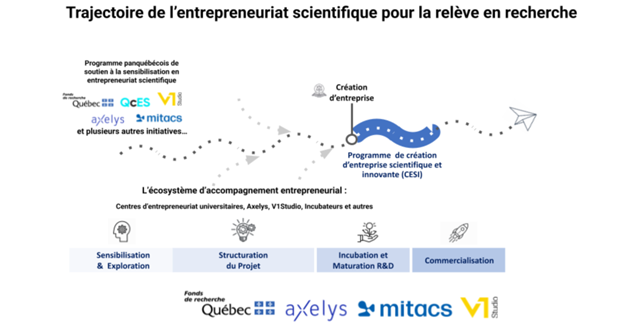
Candidates are expected to be able to demonstrate that they have:
- basic entrepreneurial skills;
- an innovative project that requires research and development;
- taken steps showing serious commitment to the entrepreneurial path.
The CESI team uses the innovation readiness level scales developed by KTH Innovation to specify the business project profile targeted by the program. The eligible readiness levels for the CESI program are as follows (see the accompanying document for details):
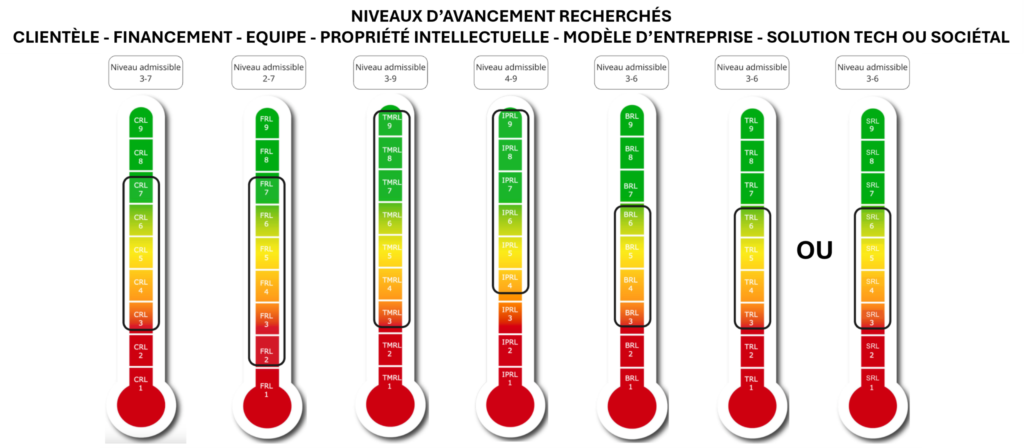
The partners encourage people from diverse backgrounds to apply, regardless of the research area and the innovation carried by the candidate.
3. ELIGIBILITY
3.1 Candidate eligibility
Only one candidate per company will be deemed eligible (the first to submit an application).
To be eligible, the candidate must:
- hold a doctoral (PhD) degree awarded within the last 5 years, counting from the year the call for applications open (e.g., a call for applications opening in 2026 makes eligible PhD holders who graduated on or after January 1, 2021). Candidates who have not yet received their degree but have submitted their doctoral thesis before starting in CESI are also accepted;
- have legal status to work in Canada before starting the CESI program and for the entire period during which the funding is used.
- if awarded, and where applicable, the candidate will be required to provide a document confirming that they are authorized to work in Canada.
Accepted documents:
o For Canadian citizens: birth certificate or Canadian passport;
o For immigrants: any of the federally issued immigration documents listed on this page.
- have oral and written proficiency in French and/or English in order to take part in the follow-up processes;
- be domiciled in Quebec (have a residential address in Quebec, be present in Quebec and available for in-person meetings for the entire funding period);
If awarded, and in order to remain eligible, the scholarship holder undertakes to:
- become a founding member of the company. Upon entering the program and for the entire funding period, the CESI candidate must hold more than 15% of the shares, and the founding entrepreneurs must collectively hold more than 50% of the company; outside partner companies may not hold a majority of the voting rights or control of the company.
3.2 Business project eligibility
To be eligible, the business project must:
- Correspond to the readiness levels on the KTH scales targeted by the CESI team, consistent with the program objectives (see section 2). The levels identified by the candidate for the business project in the application, as well as the supporting information provided (see section 4), are taken into account when assessing eligibility.
- Have raised a maximum of $125,000 in equity (investment in exchange for shares in the company) or quasi-equity (SAFE, convertible debenture, KISS, etc.). This amount includes all funding from founders, friends, family, angel investors or investment funds. It does not, however, include other types of funding such as loans, sales, grants and scholarships.
- Have conducted a minimum of 40 market validation interviews before applying to CESI program in order to be eligible for the program. By interview, the CESI team means data collected directly from a target audience of potential customers and experts in the field, through individual semi-structured interviews. Surveys with no interaction with respondents are not considered eligible interviews for the purposes of this program. In addition, the candidate must explain how the interviews contributed to advancing the business project.
If awarded, and in order to remain eligible, the scholarship holder undertakes to:
- incorporate the company in the federal or provincial business registry, with its head office in Quebec, before starting the CESI program, if this has not already been done, in order to receive the award if selected for the scholarship.
- if the intellectual property (IP) was developed using university resources, provide confirmation that an invention disclosure has been filed with their university and negotiate the terms of an IP transfer (licence or assignment) with the relevant stakeholders;
OR
if the IP was developed without any university resources, the entrepreneur must demonstrate: a) that the company owns all the IP it has developed, through a complete chain of title (assignments signed by each contributor) and/or b) that it holds, through a licence or written agreement, the rights to exploit any IP it does not own.
3.3 Award conditions related to eligibility requirements
When an application is selected for funding, final acceptance is conditional upon:
1) compliance with the commitments related to incorporation, negotiation of the use of the intellectual property, the candidate’s role as a founder of the company, and the candidate’s legal status to work in Canada.
2) the signing of an agreement with the university host institution. The matching process begins in coordination with V1 Studio after the CESI program onboarding meeting.
These conditions must be met and maintained in order to remain eligible for the program.
Important note regarding candidate eligibility
- For the eligibility period related to the requirement to hold a doctoral degree awarded within the last 5 years, the following exception measures apply😮 Extension: A candidate who interrupted or delayed their research career after obtaining their PhD, in particular due to parental leave, major family obligations, bereavement, a period of employment outside research, or health reasons, may have their eligibility period extended. For an interruption due to parental, family, health or bereavement leave, the extension granted is equal to twice the length of the leave. For an interruption due to a period of employment outside research, the extension granted corresponds to the length of the interruption. In the case of a slowdown, the Fonds determines the extension to be granted after reviewing the supporting documents provided with the application.:o Exemption: A person who interrupted or delayed their research career because of a disability may be exempted from the rules regarding the eligibility period. This exemption is reserved for persons who meet the definition of “personne handicapée” under the Loi assurant l’exercice des droits des personnes handicapées en vue de leur intégration scolaire, professionnelle et sociale (CQLR, chapter E-20.1).
A request for an exception, together with the supporting documents, must be submitted with the application (see section 4.3). If such an exception is requested, it is recommended that you first confirm its eligibility with the program officer before submitting the application form. The FRQ reserves the right to refuse any insufficiently justified request for an exception measure.
4. SUBMITTING AN APPLICATION
4.1 Submitting the application
Applications must be submitted through the “Espace demande” section of the FRQnet portal, the transactional interface used by the FRQ for submitting funding applications and managing awards. Once in the portal, you will find the application form by clicking the “Préparer une nouvelle demande de financement” button at the top of the page.
Important information for completing the form correctly:
- Consult the Standards for the presentation of attached files for the files to be attached to the form (French only).
- The application form must be completed in French (attached documents may, however, be written in French or English). The title and summary of the application must be submitted in French and may be used by the FRQ for promotion and dissemination purposes.
- Consult the documents in the “Boîte à outils” on the program web page (tab at the bottom of your screen) to complete the application form correctly.
4.2 Required documents
The electronic form must include:
- A summary of the business project for the general public (250 words maximum)
- A section on your doctoral work (2 pages maximum), including the thesis title, a summary, and a description of the link (direct or indirect) between that work and the proposed project
- The slide deck (upload in PDF format) describing the business project and its stage of development, completed using the template provided for this purpose . Applicants must use the provided template. Failure to do so will result in the application being considered ineligible.
The required elements are:
- A description of the problem your business project aims to solve and why it matters;
- The anticipated impact of your project;
- Your project’s readiness level, identified and demonstrated using the six innovation readiness level scales published by KTH Innovation (see the accompanying document for the French version);o Business model;o Customers;o Intellectual property;o Team;o Funding;o Technological or societal solution (you may use the KTH technology readiness scale or an adaptation designed to assess the readiness level of a societal solution proposed by Innovation Fund Denmark; see the accompanying document for the French version).
Please justify, using examples or concrete evidence, why your project is at that readiness level on each of the scales. This detail is essential to help the evaluation committee clearly understand where your project stands.
Important note: the slide deck is used both to confirm the project’s eligibility and for the committee’s evaluation of the application, as described in section 5.
- An FRQ narrative CV (6 pages maximum) of the candidate, prepared according to the following instructions: CV-FRQ_instructions.pdf. More information on the FRQ narrative CV is available here: https://frq.gouv.qc.ca/cv-frq/. For this program, we invite you to limit the information in the CV to what is directly related to the proposed project, ideally 1-2 pages.
- A copy of the doctoral (PhD) diploma or proof of thesis submission.
4.3 Important notes regarding the required documents
- Do not include letters of support or recommendation; the hosting agreement negotiations with the universities begin only once the candidate is selected to enter the CESI program.
- Although the FRQ excellence scholarship is a postdoctoral-type award, there is no requirement for the university host institution to be different from the one that awarded the PhD.
- Candidates who wish to request an exception measure regarding the eligibility period related to the requirement to hold a doctoral degree awarded within the last 5 years must provide the following documents:
o For an extension request:
o Justification for the request to extend or be exempted from the eligibility period (1 page maximum): the candidate must justify the exception request and, for an extension request, provide the dates and length of the interruptions.
o Supporting documents: the supporting documents for the exception request (e.g., medical certificate, recognition of disability, child’s birth certificate, caregiver tax credit claim, official document or letter from the employer, etc.) enable the Fonds to determine the length of the extension to be granted. Any supporting document submitted in a language other than French or English must be accompanied by a translation.
o For an exemption request related to a disability:
o Justification for the request to extend or be exempted from the eligibility period (1 page maximum): the candidate must justify the exception request and, for an extension request, provide the dates and length of the interruptions.
o Supporting documents (e.g., medical certificate, recognition of disability, child’s birth certificate, caregiver tax credit claim, official document or letter from the employer, etc.). Any supporting document submitted in a language other than French or English must be accompanied by a translation. These documents will not be forwarded to the evaluation committee.
These documents must be attached in the “Autres documents” section of the form and will not be forwarded to the evaluation committee.
4.4 Important notes regarding submission of the application
- Documents sent by email or regular mail are not accepted.
- Required items that are missing, illegible or non-compliant will not be requested and will make the application ineligible.
- Excess pages or documents that are not required but submitted with the application will be removed from the file before evaluation.
- Items received after the competition closing dates and times will not be considered. Files will not be updated.
5. EVALUATION
Phase 1. Eligibility review by the CESI team
The first step is to confirm the eligibility of applications. In addition to meeting the candidate eligibility criteria (section 3.1) and the compliance of the submitted documents (as described in section 4), the attached slide deck (upload in PDF format) must clearly demonstrate that the milestones corresponding to the business project profile targeted by the program have been reached (minimum and maximum levels on the KTH Innovation scales), in accordance with the project eligibility criteria (section 3.2). During this process, the candidate may be contacted by the CESI team to clarify certain answers provided.
Phase 2. Evaluation by an independent committee
Applications are evaluated by committees made up of members recognized for their skills, expertise and achievements related to the program objectives and the applications submitted. Given the highly diverse profiles of committee members, it is recommended that the project be presented in a way that is easy for an interdisciplinary and cross-sector committee to understand.
To be recommended for funding, an application must obtain a minimum overall score of 70%.
Evaluation criteria
- Quality of the business project (40%) (taking into account its innovation readiness levels)
- Clarity and relevance of the problem to be solved and of the proposed solution.
- The company stands out significantly from the competition, and its commercialization strategy and business model show a coherent and promising vision.
- The company has an intellectual property strategy with the potential to support its commercialization strategy.
- The founding team demonstrates strong entrepreneurial potential, appears committed, and includes the right people to reach the next inflection point.
- The technological challenges/uncertainties associated with the project are clearly identified and can be addressed.
- Demonstration that the entrepreneurial approach is realistic and has potential for success in the company’s sector.
- Project impact (societal, economic, environmental) (30%)
- The company is aware of its negative externalities and takes action to minimize them
- The company demonstrates a positive social, environmental or economic contribution
- Anticipated benefits of participating in the CESI program (30%)
- Potential impact of CESI funding and support o For the candidateo For the company
- Demonstration of the need to be hosted by a university
6. NATURE OF THE FUNDING
- An FRQ excellence scholarship of $75,000 (equivalent to a postdoctoral fellowship), paid to the individual. The award is for a period of 18 months;
- Advice and support for adding complementary funding;
- Once final acceptance is received, support from V1 Studio and, as needed, from Axelys (for more details, see section 7).
The FRQ scholarship allows the candidate to devote their time to developing their company (business and commercialization strategy, business and partnership development, market validation, etc.) and to continue acquiring key skills (business coaching, coaching on transferable skills, intellectual property knowledge, etc.).
Mitacs Accelerate funding may be added to support the development of the innovation at the heart of the business project. This secures additional resources and expertise and strengthens the required connection with the university. However, the private-sector contribution required for this funding must come from a financial source independent of the FRQ excellence scholarship. The candidate will be required to agree to comply with this requirement before each FRQ scholarship payment.
The candidate may not hold a CESI scholarship concurrently with Mitacs Accelerate Entrepreneur units. However, the candidate may continue to receive Mitacs Accelerate Entrepreneur units during the application period and the selection process. If selected for the CESI scholarship, the Mitacs funding must be paused before the first FRQ scholarship payment, until the end of the scholarship period. The CESI team provides support with this process.
Please refer to the current rules on the Mitacs website for additional information.
Axelys’s mission is to transfer innovations from university laboratories to startups and industry. To do so, it supports startups with their technology maturation, intellectual property strategy and financing strategy. Its team contributes to the CESI program by co-supporting the selected projects along their journey with its leading-edge expertise, as well as providing access to complementary funding programs.
The V1 Studio team specializes in developing individuals transitioning from an academic project to an entrepreneurial project. It leverages its ties with all Quebec universities and a large number of incubators and accelerators to identify opportunities specific to science-based companies in the ecosystem. The V1 Studio team provides support from the very start of the CESI program, notably through personalized planning of skills development, project advancement and ecosystem connection plans, as well as follow-up meetings to update the objectives to be achieved (for more details, see section 7).
The FRQ excellence scholarship under this call is for the exclusive benefit of the person selected for the CESI program and should not be used in the financial package of projects submitted to other government programs, including those of the Ministère de l’Économie, de l’Innovation et de l’Énergie (MEIE), the Economic Development Fund (managed by Investissement Québec) or any other MEIE mandatary organization, including Mitacs and the industrial research sector clusters.
It is the candidate’s responsibility to check with the CESI program team regarding their financial package if additional complementary funding is being considered, to ensure they remain eligible for the FRQ scholarship.
7. IMPORTANT DATES
October 27, 2026: program launch, with these rules and the form posted online.
November 18, 2026, from 12 p.m. to 1 p.m. EST: information webinar; registration is mandatory Click here if interested. Once available, the webinar recording will be added to the toolbox.
December 17, 2026 at 4 p.m. EST: application deadline.
April 2027: announcement of results.
8. FOLLOW-UP AND REPORTING
8.1 Follow-up
Following an onboarding meeting for the CESI program with V1 Studio, a personalized annual plan is established, notably including skills development, project advancement and ecosystem connection plans. Coaching meetings are scheduled every two weeks. Objectives and milestones are reviewed quarterly.
An experience report, the format of which will be communicated in due course, must be submitted to the FRQ.
8.2 Scholarship terms of use
To keep the scholarship, the person entering the CESI program must:
- Comply with the residency conditions for the entire duration of the scholarship;
- Comply with the conditions related to the rules and expectations set by the university host institution;
- Have made the initial thesis submission in order to begin the fellowship, and have met the requirements for obtaining the PhD by the time of the second payment;
- Devote themselves full-time to creating their company. An annual vacation period is permitted and must be set in advance, upon entering the CESI program with V1 Studio, so that it can be built into the advancement plans and quarterly objectives;
- Be available for periodic meetings with V1 Studio;
- Comply with the rules on permitted concurrent awards (section 8.3);
- Comply with the rules on paid employment (section 8.4).
Failure to comply with these rules may result in cancellation of the scholarship. If, for exceptional reasons, these conditions cannot be met, the FRQ must be notified as soon as possible to determine whether the scholarship can be maintained or must be cancelled.
8.3 Holding concurrent awards
This scholarship may not be held concurrently with:
- Merit-based scholarships from Canadian granting agencies such as the Social Sciences and Humanities Research Council of Canada (SSHRC), the Natural Sciences and Engineering Research Council of Canada (NSERC), the Canadian Institutes of Health Research (CIHR), the Canada Council for the Arts (CCA), etc.;
- Merit-based scholarships from Quebec granting agencies such as the Fonds de recherche du Québec (Society and Culture, Health, and Nature and Technology sectors), including awards under the Inventech (FRQ-Axelys partnership), Science Impact (managed by Esplanade and funded by the FRQ) and Grad2VC (managed by Front Row Ventures and funded by the FRQ) programs, the Conseil de recherches en pêche et agroalimentaire du Québec (CORPAQ), etc.;
- A scholarship under the Mitacs Entrepreneur Accelerator program (see section 6 for details).
- A grant from the Canada Council for the Arts (CCA) or the Conseil des arts et des lettres du Québec (CALQ) awarded for the same project.
This scholarship may be held concurrently with:
- Scholarships from the private sector and internal university scholarships.
The FRQ excellence scholarship under this call is for the exclusive benefit of the person selected for the CESI program and should not be used in the financial package of projects submitted to other government programs (see section 6 for details).
8.4 Paid employment
The person entering the CESI program retains the right to engage in additional paid work, provided that:
- it does not exceed 250 hours worked per 4-month period;
- it does not hinder the achievement of the objectives set out in the skills development, project advancement and ecosystem connection plans.
The FRQ considers that a 45-hour course load represents 150 hours of work. Note that the same course taught to two groups during the same term is equivalent to two course loads.
8.5 Deferral and supplement for parental leave for the FRQ scholarship
Please refer to section 6.13 of the FRQ’s CGR.
9. EFFECTIVE DATE
These rules apply to the 2026-2027 and 2027-2028 fiscal years.
10. THE PARTNERS
FRQ:
The Fonds de recherche du Québec (FRQ) is a government agency whose mission is to support the strategic and coherent development of scientific research in Quebec in the natural sciences and engineering, health sciences, social sciences and humanities, and arts and letters. Its Grand Societal Challenges Directorate (DGDS) stimulates solution-oriented intersectoral research based on the co-construction of knowledge and practices and on connecting science and society.
Axelys is the corporation for the development and transfer of innovations stemming from public research in Quebec. It contributes to the province’s economic and social prosperity by accelerating the maturation and deployment of high-potential inventions, know-how and processes, turning them into innovations capable of improving the world we live in. It also contributes to the creation of science-based companies stemming from public research.
For more than 20 years, Mitacs has been helping organizations achieve their business goals, funding cutting-edge innovation, and creating job opportunities for students and postdoctoral researchers. Mitacs drives economic growth, productivity and concrete change to improve the quality of life of all Canadians. Its mission is to build a world-class community of diverse innovators through its collaborative model in order to inspire and design creative solutions.
V1 Studio is a non-profit organization that offers researchers a safe space to explore entrepreneurship. V1 Studio runs tailored programs to support researchers and graduate students (master’s and PhD) in the early stages of their entrepreneurial journey. V1 Studio helps them develop their potential and, when they are ready, create a science-based or innovative company.
11. CONTACTS
For the FRQ:
Émilie Rochette
Program Officer
Grand Societal Challenges Directorate
Office of the Chief Scientist
Email: Émilie Rochette
For the CESI program:
Email: CESI