Transition timeline


This change is in line with the approach of the federal granting agencies (SSHRC, NSERC and CIHR), which have announced that they are transitioning away from the Canadian Common CV (CCV) in favor of the new tri-agency CV.
Our new narrative CV will help streamline our funding application process and adapt our assessment practices in accordance with our participation in the Coalition for Advancing Research Assessment (CoARA) and Plan S.
The new FRQ CV also allows us to accommodate a diversity of research profiles from the academic community, as well as artists, citizens, and patient partners.
We are introducing a narrative-style CV in order to better recognize all of your scientific, professional and societal contributions. This format is not simply a free-form personal statement; rather, it is a guided narrative framework designed to showcase diverse career paths while maintaining clear and objective evaluation criteria.
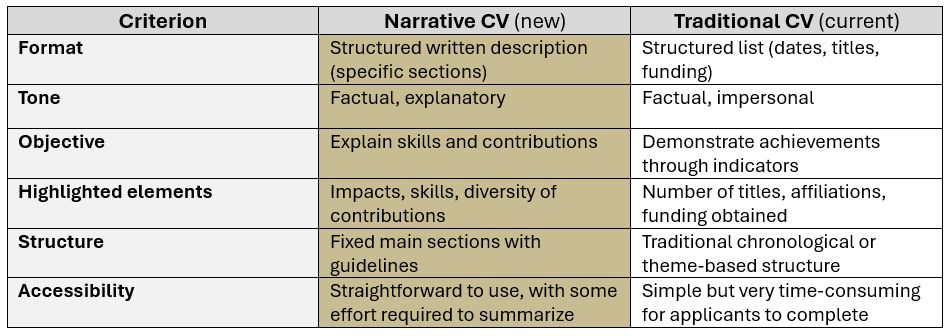
In the context of the gradual phase-out of the CCV, the FRQ is adopting this new template to harmonize its practices with those of the federal granting agencies (SSHRC, NSERC and CIHR). The new template aims to simplify the funding application process for applicants while adapting our assessment procedures to align with best practices in the field and begin the transition to a more qualitative assessment of research.
The narrative CV is less rigid and is organized by theme or major contribution. It prioritizes written descriptions that integrate personal and professional components, as opposed to the CCV which is highly structured and standardized.
The narrative CV was developed in collaboration with federal research funding agencies (SSHRC, NSERC, CIHR). The format and content of the FRQ CV are the result of this collaboration. The FRQ narrative CV was also developed as part of the implementation of the FRQnet 2.0 project. The latter aimed at modernizing the FRQ’s grants and awards management system by improving the user-friendliness, security and efficiency of the application process. FRQnet 2.0 helps meet the evolving needs of users, reduce the administrative burden, and ensure compliance with new regulatory requirements. Members of the scientific community were consulted to improve the instructions for the FRQ narrative CV.
The new narrative CV will allow applicants to better showcase the impact, significance and relevance of their contributions through written descriptions that link their achievements to their broader research objectives.
The new narrative CV provides evaluation committees with a richer and more contextualized overview of an applicant’s background. It facilitates the qualitative assessment of research by highlighting the relevance, diversity and impact of contributions, going beyond traditional indicators. Structured into clear sections, it allows for a more harmonized interpretation, supports a more equitable assessment, and promotes the recognition of diverse trajectories, including, among others, training, leadership, partnerships, and engagement. It provides additional information to the answers contained in the funding application.
The narrative CV should be considered in conjunction with the entire funding application and is not evaluated on its own.
The FRQ sets out the requirements, criteria, and expectations, but does not provide individual guidance to applicants in drafting their detailed résumés. This support is primarily the responsibility of the institutions, which are better positioned to offer assistance tailored to students’ academic backgrounds, disciplines, and institutional contexts.
If you have question or comments, please contact the manager of the program in question or our IT help centre. We are building this solution with you: your feedback is welcome to help guide future adjustments.
The CV-FRQ consists of three sections:
These sections serve as a framework for the application, but it is not required to complete every section if some are not relevant to the candidate’s contribution or role.
No. It is not mandatory to complete all sections of the CV-FRQ. The purpose of the descriptive CV is to highlight the expertise and contributions actually utilized in the context of the submitted project or program.
Therefore, if a section does not correspond to the applicant’s role or does not adequately reflect their contribution, it may be left blank or marked as “not applicable” (NA) or “n/a.” However, it is recommended to add a brief explanatory note to clarify why that section does not apply.
Candidates are not penalized for leaving a section blank when it is not relevant to their role within the team.
No. Since it is not self-contained outside the context of a funding application, the descriptive CV is not evaluated in isolation. At the FRQ, no evaluation grid includes a criterion for the CV-FRQ. The CV-FRQ serves as a contextualization tool that allows for a better assessment of the applicant’s expertise, background, and contributions in relation to the proposed project or program.
The evaluation focuses on the funding application as a whole, of which the descriptive CV is a complementary component.
Hyperlinks may be included in the descriptive CV, similar to bibliographic references, provided they are relevant and directly related to a contribution mentioned therein.
For example, a hyperlink may lead to an open-access publication or to the official program of a conference mentioned in the CV.
However, it is not permitted to include hyperlinks leading to a personal webpage presenting a comprehensive curriculum vitae or general content. Under no circumstances may hyperlinks replace information that must be presented directly in the application.
The narrative CV is closely tied to a specific project or program that aligns with the objectives of a given program. This allows applicants to tailor the presentation of their background and contributions to the context of the application.
Under these circumstances, providing a complete example might not be widely applicable and could mislead applicants regarding actual expectations, since career paths, roles, and contributions vary considerably from one person and context to another.
In the spring of 2026, the FRQ conducted a consultation with the research community (in French) to gather feedback on the CV-FRQ and identify areas for improvement.
In light of the results, the FRQ is maintaining a structured, descriptive format that is aligned with that of federal funding agencies. It is continuing its work to clarify the instructions, better align the CV with application forms and evaluation practices, refine its format, and improve the technological tools that support it.
The CV-FRQ is thus part of a process of continuous improvement, informed by the experience of the research community.


The new platform will modernize and enhance the technological infrastructure used for submitting applications and managing the funding award process.
.

All FRQ grants and scholarships awarded since 2019 now have a unique, persistent identifier.