

Competition launch date :
July 2026
Deadline (application) :
September 10th, 2026 at 16:00 (EST)
Announcement of results :
April 2027
Start year of grant :
2027-2028
Amount :
$75,000 per year ($45,000 NSERC and $30,000 FRQ)
Duration :
Maximum of 3 years

Partnership
Natural Sciences and Engineering Research Council of Canada
WEBINAR: An information session on this program will be offered in French by FRQ and NSERC on July 17, 2026, at 9:30 a.m. (60 min). This webinar is intended for the research community wishing to submit a funding application to this competition. A question-and-answer period is planned.
Registration is free and mandatory. To register, click this link.
The presentation slides are available in the toolbox below, and here.
For information purposes, a PDF version of the guide related to this competition is available in the toolbox under Quick Access.
Program Rules
Important — Sixth Edition
New:
|
The present program refers to the Common General Rules (CGR) of the Fonds de recherche du Quebec (FRQ). These rules apply to all FRQ funding opportunities. Only the specific conditions for the NOVA program are set out in this document, and they take precedence over the CGR and NSERC policies.
This program is part of the FRQ’s initiatives to recognize the diversity of knowledge and research contributions (E3R/CoARA), including Indigenous knowledge.
The full program rules are available in PDF format in the Toolbox.
The link to the FRQnet Electronic Portfolio, which contains the forms associated with this competition, is available under the “Portal access” tab on the website. Additional information is available in the “Documents” menu of the FRQnet Electronic Portfolio. It is entirely the applicant’s responsibility to select the correct form. In the event of an error, the Fonds will not transfer an application from one program to another, and the application will be declared ineligible during the eligibility review.
The Fonds requires that the narrative FRQ CV be attached to the application form. The principal investigator and co-investigators must ensure that they complete the FRQ CV by following the FRQ narrative CV Instructions and the Presentation standards for attachments to FRQnet forms, available on the FRQ CV page.
A FILE SUBMITTED TO THE FONDS AFTER THE COMPETITION DEADLINE DATE AND TIME, NAMELY SEPTEMBER 10, 2026, AT 4:00 P.M., WILL NOT BE ACCEPTED BY THE FONDS.
ATTENTION: If you submit a proposal in response to this competition, you thereby agree that the partner organizations (FRQ and NSERC) may exchange the information contained in your application, as well as the information required to monitor awarded grants. Principal investigators must ensure that all co-investigators and collaborators are aware of the rules regarding the communication of information contained in the application. No confidential personal data will be exchanged, including gender-related personal data.
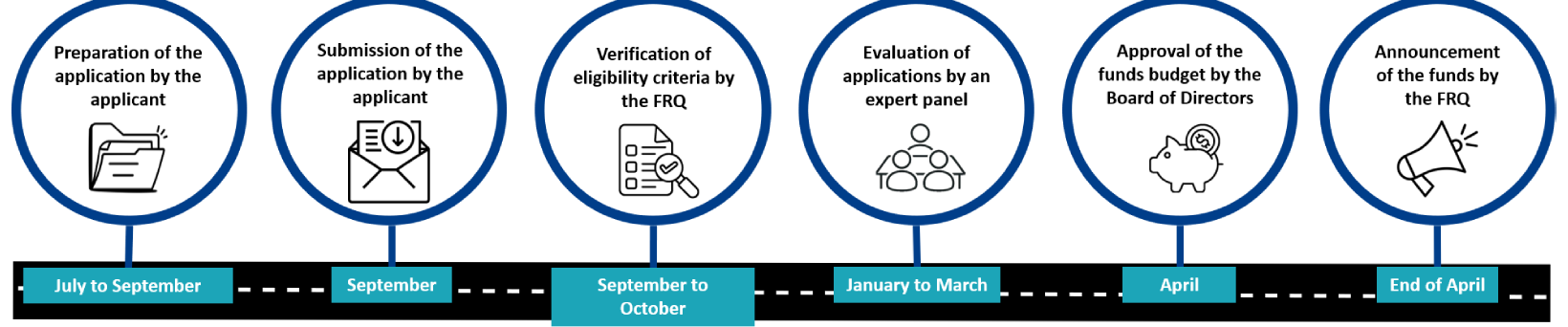
Overview of the main stages from the launch of the competition to the announcement of the awards.
1. Objectives
Offered as a partnership between NSERC and the FRQ, the main objective of the NOVA program is to support research projects led by early-career researchers in Quebec in collaboration with researchers from other Canadian provinces and territories. These projects must fall within the fields of natural sciences, mathematics and engineering (NSE).
The NOVA program has the following specific objectives:
- Increase and stimulate the research collaboration capacity of Quebec early-career researchers with other researchers from Canadian provinces and territories;
- Strengthen the international competitiveness of researchers from Quebec and from other Canadian provinces and territories;
- Generate new knowledge or applications of knowledge likely to produce social, environmental, technological or economic benefits, or to have an impact on public policy in Quebec and/or across Canada, on issues of importance to the community;
- Create a plan for mobilizing knowledge and results both in Quebec and across Canada.
2. Characteristics
The grant has a maximum duration of three years and a maximum amount of $75,000 per year. This grant is non-renewable.
The grant is provided in the form of two awards, with the amounts distributed as follows:
- $30,000 per year from the FRQ
- $45,000 per year from NSERC
Indirect research costs (IRCs) of 27% are paid to the managing institution on the FRQ financial portion and are added to this amount.
An additional maximum amount of $50,000 (including taxes) may be requested by the principal investigator for the purchase of scientific equipment. The unit cost of each piece of equipment must be $7,001 or more. This amount is awarded based on the quality of the research project, the identified needs and the limits of the budget envelope.
The NOVA program is part of a funding and career advancement continuum within a portfolio of three programs in the Nature and Technologies sector, namely:
- Research Support for New Academics
- NOVA : FRQ – NSERC
- Team Research Project.
Each of these three programs has eligibility conditions related to the applicant’s career stage. Please consult the diagram below to verify that the NOVA program applies to your situation.
2027 CAREER CONTINUUM
Number of years since the first career position as a university professor
RESEARCH SUPPORT FOR NEW ACADEMICS
NOVA : FRQ-NSERC
TEAM RESEARCH PROJECT
In position since Sept. 2, 2023
In position between Sept. 2, 2020 and Sept. 1, 2023
In position before Sept. 2, 2020
3. Eligibility
Every research project, principal investigator, research team and participating person must comply with the eligibility conditions in effect, as set out in the program rules and in the Common General Rules at the time the funding application is submitted, as well as with NSERC eligibility rules, throughout the entire award period covered by the grant. Any project, researchers, research team or participating persons that do not meet, or no longer meet, the eligibility conditions set out below will be declared ineligible. An application file that does not comply with the program rules or that does not include the information needed to establish its eligibility or evaluate it may be declared ineligible. An application forwarded to the evaluation stage may also be declared ineligible at any time.
Application eligibility is determined jointly by the FRQ and NSERC based on the information and documents received by the competition deadline date and time.
3.1 Team Composition
The team must include, at a minimum, an early-career principal investigator from Quebec, at least one co-investigator from Quebec and at least one co-investigator from another Canadian province or territory outside Quebec.
The complementarity of the expertise required to carry out the research project must be reflected in the composition of the team and must bring together the best expertise across Quebec and the other Canadian provinces and territories.
3.2 Principal investigator (PI)
The PI for the application must:
- Be a researcher at a Quebec university AND
- Hold Status 1 according to definition i) only, as defined in the FRQ Common General Rules AND
- Have accumulated more than 3 years and fewer than 6 years in a regular professor position, meaning having started between September 2, 2020 and September 1, 20231.
Status 1 researchers paid under definition ii) of the Common General Rules are not eligible as PIs, but may join the team as co-investigators (COIs).
Retired researchers are not eligible as PIs.
Participation limits apply (section 3.6).
| [1] A career position that allowed the person to supervise students and conduct research. Similar positions held outside Quebec are included in this first career-position eligibility period. Any first position held before September 2, 2020, or after September 1, 2023, makes the person ineligible, except in the case of a career interruption declared by the applicant that justifies a PEPA. |
Exceptional extension of the eligibility period (PEPA):
A PI whose research career has been interrupted or slowed down, including because of parental leave, a disability, major family obligations, bereavement or health reasons, may have their eligibility period extended. Any period during which the applicant does not hold a university position as a professor or researcher is not counted in the calculation of years of experience.
In the case of an interruption for parental, family, health, bereavement or disability-related leave, the extension granted is equal to twice the duration of the leave.
In the case of a slowdown, the Fonds determines the extension to be granted after analyzing the supporting documents provided with the extension request.
A PI who wishes to request an exceptional extension of their eligibility period is invited to complete a Web Form “PEPA REQUEST – NOVA” available from the section “Principal Investigator” of the FRQnet Form. This Web Form and the supporting documents may be submitted confidentially at any time between July 9, 2026 and September 3, 2026 at 4:00 p.m. The Fonds determines the exceptional extension to be granted based on its analysis of the documents provided and will send the response through the FRQnet electronic portfolio.
3.3 Co-investigators
From Quebec:
- At least one co-investigator from a Quebec university or college holding Status 1, 2 or 3, as defined in the Common General Rules.
Quebec COIs may be at any career stage and may be grant-funded or retired researchers, provided they have a university affiliation that allows them to independently supervise students.
Other Canadian provinces and territories outside Quebec:
- At least one co-investigator from a university or college in another Canadian province or territory AND
- From institutions eligible under NSERC rules (List of Eligible Institutions).
Co-investigators from other Canadian provinces and territories may be at any career stage and may be grant-funded or retired researchers, provided they have a university affiliation that allows them to independently supervise students.
For college co-investigators outside Quebec, you must hold a position or have received a firm offer of appointment at an eligible Canadian college. During the term of your grant, you must hold such a position, whether permanent or for a limited term of at least three years. The position you hold must allow you to conduct research-related activities without the supervision of another researcher.
Grant-funded and retired university researchers must consult section 4 to review the documents that must be provided.
3.4 Collaborators
Any person meeting Status 1 to 4, as defined in the Common General Rules, may join the team as a collaborator. A CV is not required. In addition, international researchers are also eligible as collaborators.
Collaborators do not have access to FRQ or NSERC funds; they must provide their own resources.
3.5 Intersectorality
The FRQ and NSERC encourage you to include university and college COIs from fields outside NSE on the team. Research costs associated with work not covered by NSE fields may not represent more than 30% of the NSERC financial portion. The eligibility conditions for these persons must comply with the conditions for COIs or collaborators set out above, where applicable.
3.6 Participation limits
As PI:
For each Continuum competition year, researchers may participate in a maximum of ONE application as PI, regardless of the program concerned.
No current award within the Continuum
ONE
ONE current award within the Continuum***
NONE
As COI:
For each Continuum competition year, researchers may participate in a maximum of TWO applications as COI, regardless of the program concerned.
No current award within the Continuum
TWO
ONE current award within the Continuum***
ONE
TWO current awards within the Continuum***
NONE
*** A researcher who is in the final year of a grant within the Continuum is entitled to one additional participation in this competition.
There is no participation limit for carrying out other projects as a collaborator.
3.7 Equity, diversity and inclusion (EDI)
The research team is responsible for creating a more diverse, inclusive and equitable research environment, where the climate and culture allow everyone to feel supported and respected. The concrete actions and practices that will be implemented to integrate EDI principles must be described in the training plan, with reference to NSERC guides. The implementation of EDI principles in the training plan is an eliminatory step in determining the eligibility of the funding application.
3.8 Research project
Please note that only funding applications falling within the research areas covered by the Nature and Technologies sector and NSERC are eligible. As such, it is the applicant’s responsibility to ensure that the objectives, methods and approaches, deliverables, etc. fall within the FRQ Nature and Technologies sector.
For all Continuum programs, and pursuant to section 6.12 of the Common General Rules, the FRQ reserves the right to deem ineligible research proposals submitted by the same researchers that present the same activities or whose description suggests overlap between the activities presented.
Research projects jointly funded by the FRQ and NSERC cannot simultaneously receive funding from other granting agencies.
Notice of the result of the administrative eligibility review of the application will be sent to the PI in October 2026.
4. Application
Missing elements from the file will not be requested from the applicant. Any documents received after the deadline date and time for submitting applications to the Fonds will not be considered, and files will not be updated. Any extra pages will be removed from the file. These rules will be strictly applied. Any incomplete file makes the application ineligible. Consult section 3 of the Common General Rules for the application submission procedures. Regarding the language used in the form and submitted documents, consult section 3.6 of the Common General Rules.
The funding application must be submitted in the PI’s FRQnet electronic portfolio.
All members of a NOVA team (PI and COIs from Quebec and from other Canadian provinces and territories) must have an FRQnet account.
All members of a NOVA team (PI and COIs from Quebec and from other Canadian provinces and territories) must also have an account in the NSERC online system. More information is available in the Registration and Login section of the NSERC frequently asked questions.
United Nations Sustainable Development Goals (SDGs)
In accordance with the Quebec Research and Innovation Investment Strategy 2022–2027 (SQRI²), the Government Sustainable Development Strategy 2023–2028 (SGDD 2023–2028), and in line with its Plan d’action de développement durable 2025-2028, the FRQ aims to promote the role of science and the scientific community in addressing the issues supported by the SDGs.
To this end, applicants are invited to indicate, if their project is relevant, how their research contributes to achieving the SDGs in the “Contribution to the Sustainable Development Goals” section of the application form. This information will not be forwarded to the evaluation committees. Consult the FRQ SDG guide for more details.
The PI must consult the Standards for presenting attached files (PDF) for FRQnet forms, available in the “Documents” section of the FRQnet electronic portfolio, to review all formatting instructions. The PI must also submit separate budgets and budget justifications for the FRQ and for NSERC, while complying with the eligible expenses of each organization in each budget.
4.1 Required documents
A complete application includes the following documents:
Funding application form (FRQnet electronic portfolio) including, in particular, the following:
- FRQ CV: The PI and all COIs, including COIs outside Quebec, must attach the narrative FRQ CV to the application form. The narrative FRQ CV must be completed using the FRQ CV template, following the FRQ narrative CV Instructions and the Presentation standards for attachments to FRQnet forms. All these documents are available on the FRQ CV page.
The information provided in the narrative CV must be aligned with the program objectives and evaluation criteria. It is therefore essential to review the objectives and evaluation criteria of the program for which you are submitting your application in order to determine the relevant content to include in the narrative CV.
- Eligibility supplement: In addition to the narrative CV, the principal investigator and all COIs, including COIs outside Quebec, must complete and attach the Eligibility Supplement, whose template is available in the toolbox. This document will not be forwarded for evaluation.
- Abstract: The project summary must be clearly written and must describe the main elements of the project to make it easier for readers and evaluators to understand.
- Project description: description related to the four evaluation criteria (maximum 12 pages, including the list of references, tables and figures).
- Teaching release – Quebec Colleges: identification of the team members concerned and justification for release from teaching duties (1 page), if applicable.
- Budget: Attach one consolidated PDF file including 1) the justification of planned expenses for the FRQ (maximum 2 pages), 2) the justification of equipment requested from the FRQ (maximum 1 page), and 3) the budget table and justification of planned expenses for NSERC (maximum 3 pages). Reminder: Planned expenses for the FRQ award and those for the NSERC award must be presented separately in this consolidated PDF file.
- Other documents*:
- A letter from the university institution for a retired Quebec researcher, if applicable;
- A letter from the university institution for the PI and grant-funded COIs, if applicable;
- Equipment request: two supplier quotes if the unit cost is over $25,000 (including all taxes);
*Clarifications regarding the documents to attach in the Other documents section of the form:
A. Retired Quebec researcher
The letter from the university institution must certify that the retired researcher will have access, for the duration of the grant, to office or laboratory space and the logistical support needed to carry out their research activities, and that they will continue to train students and prepare the next generation in their field. In this letter, the university must also certify that it will assume, in terms of the management and administration of funds, the same responsibilities it currently fulfills following funding.
B. Grant-funded researcher
A letter from the university institution is required for eligible PIs and COIs who hold a non-tenure-track position at their university, indicating that they will retain this status throughout the duration of the grant. A letter with insufficient documentation could result in the ineligibility of the grant-funded person.
C. Equipment request to the FRQ
Two supplier quotes, where applicable, are required for any equipment whose unit cost is over $25,000 (including all taxes). Exceptionally, a single quote may be submitted provided that it is fully justified in writing in the budget justification.
Please note that institutional approval is required before the application is submitted to the FRQ. It is therefore likely that internal deadlines earlier than those of this competition have been set by your institution. It is important to consider this aspect for both Quebec COIs and COIs from other Canadian provinces and territories. It is your responsibility to find out so that your file is submitted to the Fonds before the competition deadline date and time.
4.2 Team registration with NSERC: Simplified letter of intent
Applications to NSERC
As the applicant acting on behalf of your team, when you submit the application to the FRQ via the FRQnet portal, you must also submit a letter of intent (LOI) to NSERC. The LOI must be accompanied by a completed simplified Personal Data Form — Form 100A with the FRQ’s Eligibility Supplement form and the FRQ CV as attachments, and a description of how EDI considerations have been integrated into the training plan. If applicable, the Impact Assessment Form (Appendix A) must be completed and uploaded in the Impact Assessment section.
The applicant and all co-applicants participating in the NOVA grant application must create an account in NSERC’s online system. For more information, consult the On-line System – Frequently Asked Questions web page.
As the applicant, you are responsible for providing all of the following documents and information in your LOI:
- A simplified Personal Data Form — Form 100A for each member of the research team. For this funding opportunity, the FRQ’s Eligibility Supplement form replaces the “Contributions to research and training explanation” attachment normally included with Form 100A, and the FRQ CV replaces the Canadian CV Attachment. Each co-applicant will automatically receive a message inviting them to complete the form and explaining how to link it to Form 101.
- A description of how equity, diversity and inclusion (EDI) considerations have been integrated into the training plan (maximum one page) using the mandatory NSERC template. Once completed, the NSERC template must be attached to the application in the “Other Documents” section.
Consult the Equity, diversity and inclusion in your training plan web page and the NSERC guide on integrating equity, diversity and inclusion considerations in research for more information.
Note: The integration of EDI considerations into the training plan is an eligibility requirement. If your application does not meet this criterion, it will be rejected during the eligibility review.
- If applicable, the Impact Assessment Form (Appendix A) must be completed and uploaded in the Impact Assessment section.
- Indicate whether the proposed research activities supported by this grant aim to advance any listed Sensitive Technology Research Areas.
- The applicant must select “yes” or “no” in NSERC’s online system. For more information, consult the Tri-agency guidance on the Policy on Sensitive Technology Research and Affiliations of Concern (STRAC Policy).
- If the applicant answers “yes”, every researcher with a named role in the grant application (applicant, co-applicant or collaborator) must submit an Attestation for Research Aiming to Advance Sensitive Technology Research Areas form (PDF file to be completed online), which must be attached to the application (for more information on the procedure for submitting the form, see the relevant frequently asked question).
Note: The applicant must collect and compile all the completed attestation forms and save them as a single PDF file. Before attaching the file, the applicant must convert it from a fillable to a read-only PDF. To do this, one option is to click on Print in the form, select the PDF format as the printer, and save the file.
To create and submit an LOI:
- Open a session in NSERC’s online system and click Create a new Form 101.
- Select Research Partnerships Programs, then select Alliance Grants.
- In the Proposal Type field, select Letter of Intent.
- In the Type of Request for Proposals field, select FRQ-NOVA from the drop-down menu.
- Complete the required sections, provide the simplified Personal Data Form — Form 100A for the applicant and all co-applicants, and attach the completed EDI training plan template.
Application deadline
- You must submit your LOI using NSERC’s online system by September 10, 2026, before 4:00 pm (ET).
The deadline for submitting your LOI to NSERC is the same as the deadline for submitting the application to the FRQ.
Note: You must submit your LOI to NSERC through your Research Grants Office. Institutional approval is required before submitting the LOI to NSERC. Check your institution’s internal submission deadline, which may be earlier than the deadline for submission to NSERC. You are responsible for ensuring that NSERC receives your LOI by the deadline.”
Please note that institutional approval is required before the simplified letter of intent is submitted to NSERC. It is therefore likely that internal deadlines earlier than those of this competition have been set by your institution. It is important to consider this aspect for both Quebec COIs and COIs from other Canadian provinces and territories. It is your responsibility to find out so that your file is submitted to NSERC before the competition deadline date and time.
5. Evaluation
Applications are evaluated by Multidisciplinary assessment committees (MACs), which may request the opinion of experts to complement the committee’s expertise. MAC members also provide an opinion on the amount to be awarded for equipment, where applicable.
Applications are evaluated according to the criteria below:
Criterion 1: Project quality (35 points)
- Innovative nature in relation to the state of the art;
- Clarity of objectives and deliverables; relevance of the scope of the planned activities in relation to the expected results; justification of planned expenses;
- Relevance of the indicators and methods planned to monitor progress throughout the project and to evaluate results at the end of the project.
Criterion 2: Research team (25 points)
- Extent to which the collaboration brings together the best expertise in Quebec and across Canada to achieve the intended objectives;
- Complementarity of the expertise required to carry out the research project;
- Contribution of collaborators, where applicable.
Criterion 3: Relevance and outcomes for Quebec and Canada as a whole (20 points)
- Importance of the expected results and social, environmental, cultural, technological, economic or other impacts;
- Potential to produce new scientific knowledge;
- Extent to which the strategy selected to apply the research results will make it possible to achieve the expected results.
Criterion 4: Training plan (20 points)
- Richness of the learning experiences offered to undergraduate, master’s and doctoral students, and to postdoctoral fellows, allowing them to develop interdisciplinary, professional (e.g., leadership, communication, collaboration, entrepreneurship) and research skills;
- Experience of project members in supervising students;
- Capacity to integrate highly qualified personnel into the labour market.
The evaluation of the funding application is subject to a passing threshold of 80%.
6. Expenses
The grant must be used exclusively to fund current expenses directly related to carrying out the research project, in accordance with the eligible expenses of each organization. These expenses must be rigorously justified in the application. Any unjustified expense may be removed from the budget.
Terms for individuals whose salaries are paid from the regular budget of a government-funded institution
Except in the specific case of college researchers (Status 3), Fonds funding must not be used to pay salaries or salary supplements to the principal investigator (PI), co-investigators (COIs), or individuals whose salaries are paid from the regular budget of a government-funded institution such as a university, a ministry or its institutions, or any other government body. Please consult the Common General Rules for more details.
6.1 Eligible expenses
Under this program, the PI will receive two awards: one corresponding to the NSERC financial portion and another corresponding to the FRQ financial portion.
All expense categories provided for in the Common General Rules (Section 8) are eligible for the FRQ financial portion, except for expenses covered under section 8.7. Specific features of this program are described below.
Reminder: The FRQ grant must be used in Quebec; transfers of funds outside Quebec are not permitted unless explicitly covered in the Common General Rules.
Eligible expenses under this program for the NSERC financial portion must comply with the Tri-agency Guide on Financial Administration.
Research costs associated with work not covered by NSE fields must not exceed 30% of the NSERC financial portion and must be clearly justified in the project budget.
Terms for salary support for eligible Quebec college researchers (Status 3) from CCTTs without teaching duties
A portion of the grant awarded by the FRQ may be used to provide salary support for Quebec college researchers who are members of the team and who do not have teaching duties. This amount must be included in the budget and may be transferred by the principal investigator’s institution directly to the college institution or to the college affiliated with the CCTT, in the case of a researcher from a CCTT.
ADDITIONAL amount for teaching release for eligible Quebec college researchers (Status 3) with teaching duties
For each Quebec college researcher who is a member of the team and who has teaching duties, an additional annual amount of up to $16,000 will be paid directly to the college institution to compensate for the portion of the salary associated with the teaching release. This amount, paid directly to the administering college institution, may be used either to compensate for the portion of the researcher’s salary dedicated to the release from teaching duties or to ensure that these teaching duties are carried out by another member of the college faculty.
Equipment acquisition grant
An additional grant may be provided for the purchase of scientific equipment whose unit cost is at least $7,000 and for which the total cost does not exceed $50,000 (including all applicable taxes). This equipment grant is awarded based on the justification of expressed needs and according to the criteria outlined below. Where applicable, the reuse of equipment and the purchase of second-hand equipment are encouraged. Due to budgetary limitations, the equipment grant is not automatically awarded if funding is granted.
The equipment must be acquired within the first 12 months following the date the award letter is issued. Where applicable, the equipment grant is awarded specifically for one or more item(s) identified in the “equipment budget” section of the funding application, provided they comply with program rules and are recommended by the evaluation committee.
Only the principal investigator may receive this grant. Equipment acquired must remain at the administering institution.
For any equipment whose total cost exceeds $50,000, the equipment grant becomes effective once the principal investigator(s) provide supporting documents confirming that they have secured complementary funding for the purchase of the requested equipment. These supporting documents must be submitted to the FRQ within one year following the announcement of the grant.
Eligible equipment requests are evaluated by the multidisciplinary evaluation committee based on the following criteria:
- The relevance of the requested equipment for carrying out the research project;
- The absence of overlap between the current equipment request and any other sources of funding already obtained since the start of the applicant’s position (e.g., CFI, NSERC equipment grants, etc.);
- The availability (physical or in terms of access) of similar equipment within the institution or the region;
- The structuring impact of the equipment on the sustainability of the laboratory and on the user training plan;
- The possibility of repairing and refurbishing the equipment (if applicable);
- The possibility of using shared computing or genomics platforms (if applicable);
- The risk management plan if the equipment is not funded.
6.2 Maternity and parental leave (Students and postdoctoral fellows)
Maternity allowance for students and postdoctoral fellows
This measure aims to support the retention of women in fields related to science, technology, engineering and mathematics (STEM), where they are historically underrepresented.
A postdoctoral fellow or student enrolled in a Quebec postsecondary institution and receiving remuneration (in the form of a scholarship or salary) from a grant under this program may receive a maternity allowance paid by the FRQ for a maximum period of eight months following the birth or adoption of a child.
To be eligible, the postdoctoral fellow or student must have been receiving remuneration from a grant under this program in the Nature and Technologies sector for at least six months. In addition, she must not hold an FRQ excellence award and must not receive benefits under the Quebec Parental Insurance Plan (QPIP).
The maximum amount of the allowance is calculated based on the annual value of the scholarships offered under FRQ excellence award programs. If the postdoctoral fellow or student receives other supplements or payments related to maternity leave, these amounts must be declared to the FRQ. The amount of the allowance will then be adjusted to complement the amount received, up to the maximum amount calculated by the FRQ.
To obtain the maternity allowance, the postdoctoral fellow or student must contact the program officer by email. She will then be invited to complete a maternity allowance application form through her FRQnet electronic portfolio. She must attach the following documents:
- A copy of a medical certificate confirming pregnancy or proof of adoption of the child;
- Proof of interruption of studies issued by the Quebec postsecondary institution;
- A copy of the remuneration agreement established with the postdoctoral fellow or student;
- Where applicable, supporting documents indicating the amount of other supplements received in connection with maternity leave, to enable calculation of the complementary amount paid by the FRQ.
The maternity allowance may begin up to eight months before the birth or adoption of the child. Payment of the allowance is determined after review of the required supporting documents. The FRQ reserves the right to reject any insufficiently justified request.
The principal investigator of the grant undertakes to resume supervision of the postdoctoral fellow or student after her absence.
Paid maternity and parental leave for students and postdoctoral fellows (NSERC)
Within 12 months following the birth or adoption of a child, the agencies provide maternity or parental leave supplements to eligible students and postdoctoral trainees (Tri-agency Guide on Financial Administration, Part 5) who are the primary caregivers of the child. The amount of these supplements, paid from the agency’s grants for a maximum period of 12 months to cover the leave, is determined based on the individual’s salary or stipend at that time.
If both parents receive grant funding, they may share the leave, provided that the total duration of both leaves does not exceed 12 months. If the student or postdoctoral fellow is engaged in part-time research training, the supplement is calculated on a pro rata basis.
The maternity allowance offered by the FRQ is not cumulative with the maternity leave provided by NSERC, regardless of whether the Quebec student’s funding is awarded through the FRQ portion or the NSERC portion. It is therefore the responsibility of the Quebec student to choose the maternity support (FRQ allowance or NSERC leave) they wish to receive.
7. Management and Follow-up
The grant is awarded for a maximum period of three years. The first FRQ and NSERC grant payments are expected in spring 2027, shortly after the decision.
All requests for changes during the award period must be submitted to the Fonds through the Manage My Funding section of the FRQnet electronic portfolio (Section 6.5 of the CGR).
Each organization will provide award letters setting out the terms and conditions of the grant. Each award letter will specify the grant terms applicable respectively to the FRQ and to NSERC’s Alliance program, as well as any special conditions, where applicable.
FRQ financial portion. Any unspent balance at the end of the grant may be carried forward for one additional year only, subject to the conditions set out in Section 6.10 of the CGR.
NSERC financial portion. For any amount unspent at the end of the award, NSERC will allow the funds to be retained by the administering institution under certain conditions defined by its Finance and Awards Administration Division. These funds will be transferred to the General Research Fund (GRF).
Annual financial report:
- FRQ financial portion: the administering institution must submit an annual financial report through the FRQnet electronic portfolio no later than September 30 of each year.
- NSERC financial portion: the administering institution must submit an annual financial report to NSERC no later than June 30 of each year, as well as a final statement of expenditures.
Follow-up report – FRQ:
- A final report will be required from the award holder no later than 15 months after the grant end date (excluding any additional year, where applicable). This report must be sent to the FRQ by completing it in the FRQnet electronic portfolio.
If the final report is not submitted within the time limits prescribed by the Fonds, or if the report is not satisfactory to the Fonds, the award holder will not be eligible to receive new FRQ funding as a PI or as a COI, or may have their payments suspended until this condition is met.
8. Open Access Dissemination Policy
Peer-reviewed publications resulting from the research work made possible by this grant must be disseminated in immediate open access (without embargo) and under an open licence, in accordance with the Open Access Dissemination Policy (revised in 2022).
9. Effective date
These rules apply to the 2027-2028 fiscal year.
10. Contact person - Natural Sciences and Engineering Research Council of Canada
For questions concerning NSERC only
NSERC Contact
Alliance-Nova
11. Contact Us
For any questions regarding the FRQ, please fill out the form below. Your questions will be sent directly to the person in charge of the program:
Margaux Gourdal
Program Officer