
Competition launch date :
July 2026
Deadline (application) :
September 9th, 2026 at 16:00 (EST)
Announcement of results :
April 2027
Start year of grant :
2027-2028
Amount :
$30,000 to $40,000 per year
Duration :
Maximum 2 years
WEBINAR: An information session about this program will be held on July 16th, 2026, at 9:30 a.m. (60 minutes) for members of the research community interested in applying for funding under this competition. Registration is free and mandatory. To register, please click this link.
What’s new:
- Integration of the program into the new FRQnet Portal’s Application Space.
- A single application form is now used for this program, which includes two components (NCM and NCR).
- The Eligibility Supplement (formerly the FRQ CV Supplement) has been replaced by the “Employment and Skills” tab of the form.
- Evaluation criteria have been revised in accordance with the FRQ’s E3R action plan.
Program rules
This program refers to the Fonds de recherche du Québec (FRQ) Common General Rules (CGR), which govern all funding offers. Only rules specific to the Research Support for New Academics program are indicated in this document, and these prevail over the CGR.
This program is part of FRQ’s initiatives to recognize the diversity of knowledge and research contributions (E3R/CoARA), including Indigenous knowledge.
The full program guidelines are available in PDF format in the Toolbox.
Applications for the Research Support for New Academics program must be submitted using the application form available in the FRQnet Portal’s Application Space. To apply, candidates must first create an FRQnet account. It is the sole responsibility of the applicant to select the correct funding program, sector, and application form. In the event of an error, the Fonds will not transfer an application from one program to another, and the application will be deemed ineligible during the eligibility review.
The Fonds requires the descriptive CV of the FRQ to be attached to the application form. The candidate must ensure that this FRQ CV is completed according to the Instructions for the descriptive CV of the FRQ and the Presentation Standards available on the FRQ CV Web page.
AN APPLICATION SUBMITTED AFTER THE COMPETITION DEADLINE OF 16:00 ON SEPTEMBER 9th, 2026, WILL BE EXCLUDED BY THE FONDS.
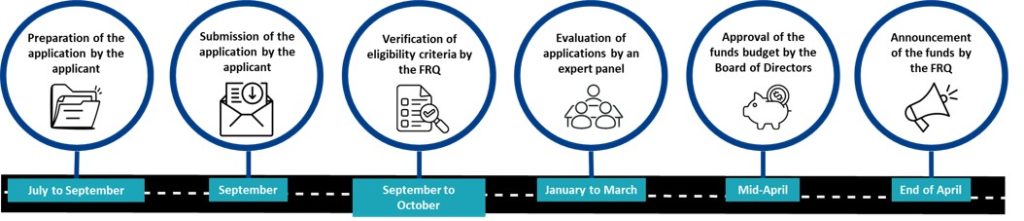
Overview of the main steps from the launch of the competition to the announcement of the awards.
1. Objectives
The Research Support for New Academics program in natural sciences, mathematics and engineering aims to:
- Contribute to fostering a new generation of researchers within the university research and teaching community by assisting new researchers who have just launched their academic career to become established as independent researchers and become competitive nationally and internationally.
- Strengthen the research system by encouraging new researchers to develop original avenues of research.
- Foster the mobilization of technological and scientific knowledge to user communities and the public.
- Inspire university students to engage in research activities.
2. Characteristics
The Research Support for New Academics program is intended for researchers at the beginning of their academic careers.
The grant is available for a maximum of two years with the following funding amounts:
- Maximum of $ 30,000 per year for:
– New researchers from institutions located within the metropolitan communities of Montréal and Québec (NCM).
- Maximum of $ 40,000 per year for:
– New researchers from institutions in the regions, i.e., those located outside the metropolitan communities of Montréal and Québec (NCR).
– New researchers who work in a regional institution whose managing institution is in the metropolitan community (NCR).
This grant is not renewable.
In addition to these amounts, indirect costs of research (FIR) of 27% are paid to the managing institution.
Equipment funding
An additional amount of up to $50,000 (including taxes) may be requested by the applicant for the purchase of scientific equipment, with the cost of each piece of equipment being $7,001 or more. This amount is awarded based on the quality of the research project, identified needs, and within the limits of the budget envelope.
The Research Support for New Academics program is part of a continuum of funding and career advancement within a portfolio of three programs of Nature et technologies sector:
- Research Support for New Academics
- NOVA-FRQ-NSERC
- Team Research Project
Each of the three programs has eligibility requirements related to the career stage of the principal investigator (PI) of the application.
Please refer to the diagram below to verify that the Research Support for New Academics program applies to your situation.
CAREER CONTINUUM 2027
Number of years since the PI’s first position as a university professor
RESEARCH SUPPORT FOR NEW ACADEMICS
NOVA: FRQ-NSERC
TEAM RESEARCH PROJECT
Holding the position since Sept. 2, 2023
Holding the position between Sept. 2, 2020 and Sept. 1, 2023
Holding the position before Sept. 2, 2020
3. Eligibility
All research project and principal investigator (PI) must meet the eligibility requirements in effect, as set out in the program rules and the General Common Rules (GCR), at the time the funding application is submitted and throughout the entire grant period. Any project or PI that does not meet, or no longer meets, the eligibility requirements outlined below will be deemed ineligible.
Applications that do not comply with the program rules or lack the necessary information to determine eligibility or to be evaluated will be deemed ineligible by the Fonds. Furthermore, an application that has advanced to the evaluation stage may be deemed ineligible at any time.
3.1 Principal Investigator (PI)
To be eligible, the PI must have Status 1 as defined in the CGR and meet the following conditions:
- Have held a regular position as a university professor for less than 3 years, i.e., since September 2nd, 2023, or later, but no later than September 2nd, 2027.
- Similar positions held in Québec or outside Québec must be included in this 3-year eligibility period. (See Section 4-Application: Letter from the PI’s institution).
- As a contracted professor, the PI must occupy a position or have received a firm offer of appointment to a position with an annually renewable contract in a Québec University. The appointment must have been ratified by the responsible authority for university appointments (or their representatives) according to the university’s constitution. The position held must allow the PI to perform research without any supervision from another researcher and to individually supervise undergraduate or graduate students or postdoctoral fellows.
- The PI must have obtained its doctorate or PhD or successfully defended its doctoral dissertation no later than September 2nd, 2026.
- The PI must benefit from a teaching release of at least 25% to carry out the research project for the duration of the grant, i.e., from April 2027 to March 31, 2029. The managing institution must provide a letter of confirmation (see Section 4-Application: Letter from the PI’s institution). This condition cannot be complied retroactively.
A PI is ineligible for this program if:
- The PI whose research project is in a field that is not covered by the vision and research fields of the Nature et technologies sector ;
- The PI who is applying simultaneously for, or has been or is currently funded by, any of the following programs:
– Research Support for New Academics of the Nature et technologies sector (NC).
– Research Support for New Academics of the Société et culture sector (NP).
– Research-Creation Support for New Academics of the Société et culture sector (CCZ).
– Research Scholars, Junior 1 of the Santé sector (CB).
Also, within the framework of all Continuum programs, and in accordance with Section 6.12 of the CGR, the FRQ reserves the right to declare ineligible any research proposals submitted by the same researcher that present the same activities or whose description suggests overlap.
Exceptional Extension of Eligibility Period (PEPA)
A PI who has interrupted or delayed its research career due to parental leave, disability, major family obligations, bereavement or for health reasons, may have its eligibility period extended.
a) In the event of an interruption for parental, family, health, bereavement or disability-related leave, the extension granted is equivalent to twice the duration of the leave.
b) In the event of a slowdown, the Fonds determines the extension to be granted after analyzing the supporting documents provided with the PEPA application.
A PI who wishes to apply for an exceptional extension of its eligibility period is invited to complete the Web Forms Request PEPA available in the Preadmissibility tab.
This Web Forms and supporting documents can be sent at any time between July 9th, and September 2nd, 2026, at 16:00. The Fonds determines the exceptional extension to be granted based on the documents provided and will send the response via a secured file sharing folder.
3.2 Participation Limits as PI
The PI may submit a maximum of two applications for funding during its eligibility period.
Also, per Continuum competition year, the PI may participate in a maximum of ONE application, regardless of the program involved.
3.3 Research Project
Please note that all funding applications must fall within the scope of the Nature et technologies sector’s research fields, as listed on our website, are eligible. As such, it is the responsibility of the applicant to ensure that the objectives, methodology and approaches, deliverables, etc., fall within the scope of the FRQ’s Nature and technologies sector.
For all Continuum programs, and in accordance with Section 6.12 of the Common General Rules (CGR), the FRQ reserves the right to deem ineligible research proposals submitted by the same researchers that present the same activities or whose description suggests there is an overlap among the activities presented.
The outcome of the administrative eligibility analysis will be sent by email to the PI in November 2026.
4. Application
The PI will not be notified of any elements missing in its application. Any documents received after the application deadline will not be considered and applications cannot be updated. Pages that exceed the maximum page limit will be removed. These rules will be strictly applied. An incomplete application will be deemed ineligible. See Section 3.6 of the CGR for information on the language of submitted forms and documents.
From now on, a single application form is available for both components of the Research Support for New Academics program. Each component corresponds to the geographic location of the PI’s university’s head office, as follows:
NCM component: For universities located in the metropolitan communities of Montréal (MMC) and Québec (QMC).
NCR component: For universities in the rest of Québec (outside the MMC and QMC).
Also applies to regional academic institutions whose managing institution is in a metropolitan community (CMM or CMQ).
A complete application includes the following documents:
The funding application form (FRQnet Portal’s Application Space) including the following tabs:
- Abstract: The project abstract must be clearly written and should describe the main elements of the project to facilitate understanding by reviewers and evaluators.
- Description of the research project (maximum 7 pages, including figures and tables): description related to the evaluation criteria presented in Section 5.
- Bibliography (maximum 1 page): Attach the references related to the project proposal description.
- FRQ CV: The applicant must complete the descriptive CV of the FRQ in the FRQ CV Section of the FRQnet Portal’s Application Space, according to the Instructions for the descriptive CV of the FRQ available on the FRQ CV Web page.
The information provided in the descriptive CV must align with the program’s objectives and its evaluation criteria. Therefore, it is essential to review the objectives and evaluation criteria of the program to which you are applying to determine the relevant content to include in the descriptive CV.
- Employment and Skills:
Complete this tab of the form to indicate your employment history. Also attach the institution’s attestation letter as described below.
Attestation letter from the PI’s institution: A letter written and signed by the managing institution, attesting:
a) That the PI holds or will hold a full-time tenure-track position (no later than September 2nd, 2027).
b) That the PI will be released from at least 25% of its teaching duties to carry out the research project for the duration of the grant (2027-2029).
c) The hiring date and position held (DD-MM-YYYY).
d) Where applicable, employment start and end dates (DD-MM-YYYY) for all full-time tenure-track professorial positions previously held by the PI at other universities in Québec or outside of the province of Québec.
Include any official documents that provide a definition of the position occupied at another Canadian or a foreign university.
In case of doubt as to the nature and duration of previous positions, the Fonds reserves the right to contact the appropriate university authorities to obtain further information.
e) If applicable, that the PI’s salary will be paid by the university or another source for the duration of the grant, in the case of a contracted professor.
f) If applicable, that the PI has successfully defended their dissertation and that graduation is a mere administrative formality.
g) If applicable, that the PI affiliated with an NCM managing institution will perform most of their functions in an NCR institution for the duration of the funding.
- Justification of planned expenditures (maximum 1 page): Provide a complete list of eligible expenses (see Section 8 of the CGR and Section 6 of the program rules).
- Justification of planned expenditures for the equipment grant (maximum 2 pages): if applicable.
This complement to the grant covers requests for equipment whose total cost exceeds $7,000. The equipment grant must be spent during the first 12 months after receiving the funding letter.
Equipment that requires an assembly of modules or accessories to be functional may be accepted. The relevance of the assembly must be clearly indicated in the application (diagrams, etc.)
This justification will be used for the assessment of the Research Project criteria.
Ensure clear explanations for the following:
a) The relevance of the requested equipment for the successful completion of the research project.
b) Lack of overlap between this equipment request and any other sources of funding already obtained by the applicant since taking up their position (CFI or NSERC equipment grant, etc.).
c) The availability (physical or usage) of similar equipment in the PI’s institution or in the region.
d) The structuring impact of the equipment on the sustainability of the laboratory and the training plan for users.
e) The possibility of repairing or refurbishing existing equipment (if applicable).
f) The possibility of using computing or genomics platforms (if applicable).
g) Risk management plan if the equipment is not funded.
For each of the following categories, a description and appropriate justification is also required:
Equipment with a value of $7,001 to $25,000: No quote required.
Equipment with a value of $25,001 to $50,000: When the cost of a single piece of equipment exceeds $25,000 (including taxes, in Canadian dollar), two quotes from suppliers must be provided in the budget tab (20 pages).
Exceptionally, a single quote may be accepted if provided with a full justification in the corresponding section of the form.
The assembly of equipment whose total cost exceeds $25,000 (including taxes, in Canadian dollar) requires at least one quote.
Equipment with a value over $50,000: For equipment whose total cost exceeds $50,000, two quotes from suppliers must be provided in the budget tab.
Furthermore, the PI must specify the source of complementary funding in the description of planned expenditures for the equipment grant.
If, at the time of application, the PI does not have the complementary funding, the managing institution must undertake to pay the necessary amount before the first instalment of the grant year (June 1st).
A letter of undertaking from the managing institution must be included with the application in the “Budget” tab of the form.
- List of suggested experts: The PI must suggest 10 experts who will be able to assess the scientific merit of the project (see the Q&A in the Toolbox for further details). The experts must have no current or recent (five years or less) collaborative relationship with the PI (see Section 4.2 of the CGR for examples of conflicts of interest situations).
Please note that institutional approval is required before the application is submitted to the FRQ. It is therefore likely that your institution has established an internal deadline that is earlier than that of the competition.
It is your responsibility to be informed of this to ensure that your application is submitted to the Fonds before the competition deadline.
5. Evaluation
Applications are evaluated by multidisciplinary evaluation committees, which may call on other experts to complement the committee’s expertise.
The internal evaluation process including funding decisions is explained in Section 4 of the CGR.
Funding applications are evaluated based on the following criteria, whose description are intended to guide reflection on the aspects to be demonstrated in the funding application.
This criterion evaluates the project based on the originality, rigor and relevance of the proposed methodology, its scientific and technical feasibility, and the consistency between the objectives, approaches, timeline, and requested or available resources.
Hypothesis and Objectives
- Is the topic under study relevant and well justified considering the current state of knowledge?
- Is the research hypothesis plausible and does it address the identified problem?
- Are the objectives clearly stated and aligned with the research hypothesis?
Approach
- Does the project propose creative, original, and innovative approaches with disruptive potential that could lead to advances in the field?
- To what extent is the proposed methodological, scientific, and technical approach aligned with the project’s objectives? Does it enable the achievement of the stated hypotheses, objectives, and expected outcomes?
- If applicable, is the equipment request relevant and sufficiently justified? Does the risk management plan clearly describe how the project will proceed if the equipment is not funded?
Feasibility and Quality of Presentation
- Is the project feasible within the proposed timeline, considering the budget and allocated resources? Is the budget realistic and well justified?
- Is the proposal clearly written and well structured?
This criterion assesses the potential impact of the project, including through training of highly qualified personnel (HQP) and knowledge mobilization activities.
Support for Highly Qualified Personal (PHQ)
- To what extent does the proposal demonstrate a commitment to fostering an inclusive, respectful, and collaborative research environment, particularly through fair and equitable recruitment practices, adapted mentoring and training approaches, and conditions conducive to the support and development of HQP?
Collaborations and Partnerships
- To what extent does the research environment support the development of collaborations and partnerships in Québec, Canada, or internationally? If applicable, are the relevance and added value of contributions to the project well described?
Knowledge Democratization
- What knowledge democratization strategies and approaches (dissemination, valorization, and accessibility) will be implemented? How does the diversity of these approaches effectively reach the academic community, user communities and the public?
- What are the anticipated economic, environmental, and societal impacts of this research project for Québec?
This criterion assesses the applicant’s ability to demonstrate leadership and research engagement in its field of expertise through its academic path, personal or professional experience, established collaborations, and track record of knowledge dissemination.
Research Engagement
- To what extent are the skills and expertise acquired through academic, professional, or personal experience, as well as the applicant’s scientific or technological contributions and achievements, aligned with the objectives of the proposed research project?
- How do the quality of the applicant’s scientific or technological contributions and achievements, as well as the diversity of activities throughout its career:
i) Contribute to the development of its leadership and unique research vision?
ii) Demonstrate its research potential, engagement in its field, capacity for risk-taking, development of collaborative networks, including user communities where applicable, and its supervising and mentoring approach?
Track Record of Knowledge Dissemination
- Does the applicant’s history of knowledge dissemination and mobilization demonstrate its ability to structure communication and mobilization strategies tailored to different target audiences? How scientific contributions have been promoted and disseminated within the academic community? How knowledge mobilization has been highlighted toward user communities and how outreach to the public has been achieved?
To be successful, funding applications must receive a passing score of 80%.
6. Expenses
The grant must be used solely for funding the current expenses directly related to carry out the research project.
All budget items listed in the CGR (Section 8) are eligible. Specific details for this program are described below.
Maternity allowance for students and postdoctoral fellows
This measure is designed to encourage the retention of women in science, technology, engineering and mathematics (STEM) fields, where they have historically been under-represented.
A female postdoctoral fellow or student enrolled at a Québec postsecondary institution who receives remuneration (in the form of an award or salary) funded by a grant under this program may receive a maternity allowance paid by the FRQ for a period of up to eight months for the birth or adoption of a child.
To be eligible, the postdoctoral fellow or student must have been receiving the remuneration under this Nature et technologies sector grant for at least six months. In addition, she may not hold a FRQ excellence award and may not receive benefits from the Québec Parental Insurance Plan (QPIP).
The maximum amount of the allowance is calculated based on the annual value of an FRQ excellence award. If the postdoctoral fellow or student receives other supplements or payments in connection with the maternity leave, these amounts must be declared to the FRQ. The allowance will then be adjusted to top up the amount already obtained, up to the maximum calculated by the FRQ.
To obtain the maternity allowance, the postdoctoral fellow or student should contact the program officer by email. She will be asked to fill out a maternity allowance request form in her FRQnet Portal’s Application Space. The following must be attached to the form:
- A copy of the medical certificate confirming pregnancy, or proof of adoption of the child;
- Proof of interruption of studies issued by the Québec university institution;
- A copy of the postdoctoral fellow or student’s remuneration contract;
- If applicable, supporting documentation indicating the amount of any other supplements or payments received in connection with the maternity leave must be provided to calculate the FRQ top-up amount.
The maternity allowance may begin up to eight months before the birth or adoption of the child. The FRQ will transfer the maternity allowance to the postdoctoral fellow or student upon receipt and analysis of the required documents. The FRQ reserves the right to reject any request with insufficient supporting documentation.
The principal investigator of the grant must agree to resume supervision of the postdoctoral fellow or student after her absence.
7. Management and follow-up
See Sections 5 to 7 of the CGR.
Grants are awarded for a maximum of 2 years. Funding is disbursed annually for the period from April 1st to March 31st of each year.
All requests for changes during the funding period must be sent to the Fonds via the FRQnet Portal (Section 6.5 of the CGR).
The unspent balance remaining at the end of the funding period may be carried forward for an additional period of one year only, subject to Section 6.10 of the CGR.
Funding condition for professors who will occupy a position as of September 2nd, 2027
A PI who will occupy a Status 1 position no later than September 2 of the year following this competition must have legal status to work in Québec no later than April 30th, 2027 (see Section 2.1 of the CGR).
Funding condition for equipment grants
The equipment grant can only be used to purchase the equipment originally requested in the application (any equivalent purchases will need to be justified).
Equipment acquisition must be made within the first 12 months after receiving the funding letter. The grant for the purchase of equipment is funded, if applicable, specifically for one or more item(s) identified in the “equipment budget” section of the funding application, which are also in accordance with the program rules and recommended by the evaluation committee.
Equipment over $50,000
For the contribution of the Fonds to come into effect, the PI must provide supporting documents indicating the sources of complementary funding for the purchase of the requested equipment before June 1st of the funding starting year.
Final report
The final report is administrative and allows the FRQ to document the impact of the funding it offers. The funding holder must complete and submit the final report, which will be available in the FRQnet Portal, no later than 6 months after the submission of the last financial report.
If the final report is not submitted within the time prescribed by the Fonds, or the report is not to the satisfaction of the Fonds, the funding holder is not eligible to receive new funding as PI or Co-I from any of the Fonds or may have their payments suspended until the situation has been remedied.
8. Open access policy
Peer-reviewed publications resulting from the research made possible by this grant must be released as immediate open access (without embargo) and under an open license, in accordance with the FRQ Open Access Policy (revised in 2022).
9. Effective date
These rules apply to the 2027-2028 fiscal year.