
Competition launch date :
July 2026
Deadline (application) :
September 15th, 2026 at 16:00 (EST)
Announcement of results :
April 2027
Start year of grant :
2027-2028
Amount :
$50,000 per year
Duration :
Maximum of 3 years
WEBINAR: An information session on this program will be held on July 14, 2026, at 9:30 a.m. (60 min) for the research community wishing to submit a funding application to this competition. Registration is free and mandatory. To register, click on this link.
APPLICATION FORM : The application form can be found in the Electronic Portfolio of the Previous FRQnet Portal in the section Available competitions.
New:
- Introduction of the new FRQ CV to be submitted as part of the application. From now on, FRQ-CV replaces the Canadian Common CV and the Detailed Contributions document.
Program rules
The Team Research Project program refers to Fonds de recherche du Québec (FRQ)’s Common General Rules (CGR), which govern all programs offered by FRQ. The information below provides guidelines specifically applicable to the Team Research Project program, and these rules take precedence over the CGR.
This program is part of FRQ initiatives to recognize the diversity of knowledge and research contributions (E3R/CoARA), including Indigenous knowledge.
The rules of this program are available in full and in PDF format in the Toolbox.
A link to the FRQnet Electronic Portfolio, which contains the forms associated with this competition, may be found by visiting the “Portal Access” section of FRQ’s website. More information is also available in the FRQnet Electronic Portfolio under “Documents.” Please note that it is the applicant’s responsibility to use the correct application form. In the event that an error is made, the FRQ will not transfer the application from one program to another and the application will be deemed not eligible.
FRQ requires that the narrative FRQ CV be attached to the application form. The principal investigator and co-investigators must ensure that they complete the FRQ CV in accordance with the FRQ narrative CV Instructions and the Presentation standards for attachments to FRQnet forms, available on the FRQ-CV web page.
APPLICATIONS SUBMITTED AFTER THE COMPETITION DEADLINE OF SEPTEMBER 15, 2026 AT 4:00 PM WILL BE DEEMED INELIGIBLE BY THE FRQ.
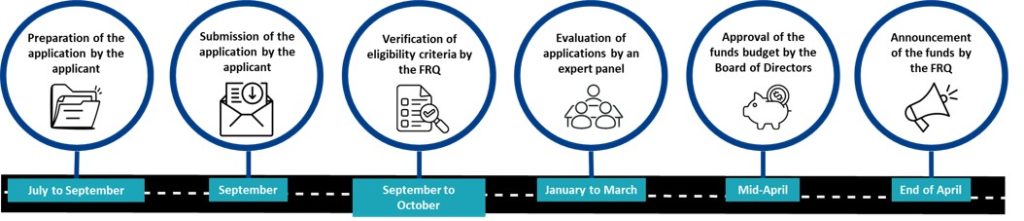
Overview of the key steps from the launch of the competition to the announcement of the awards
1. Objectives
The purpose of the Team Research Project program is to:
- Foster the emergence of new research areas in the scientific fields that are within the FRQ Nature and technologies sector’s scope
- Enhance the ability of Québec researchers to compete in federal and international funding competitions by developing innovative projects
- Encourage researchers with complementary expertise to collaborate together in developing research projects
- Promote high quality environments that will provide opportunities for the training, mentoring and skill development of students
2. Characteristics
Grants may be awarded within the Team Research Project program for a maximum of three years and up to $50,000 per year. This grant is non-renewable.
Indirect costs of research (ICR) will be paid to managing institutions. The ICR will equal 27% of the grant awarded and is in addition to the grant amount.
The Team Research Project program is part of a funding and career advancement continuum that includes the following three Nature and technologies sector programs:
- Research Support for New Academics
- NOVA: FRQ-NSERC
- Team Research Project
Each of these three programs has eligibility requirements related to the career stage of the principal investigator (PI) of the application. Please refer to the chart below to determine if the Team Research Project program applies to your situation.
For Principal Investigators who fall under the Status 3 category, please refer to the eligibility requirements outlined in Section 3 further below.
CAREER CONTINUUM 2027
Number of years since the PI’s first position as a university professor
RESEARCH SUPPORT FOR NEW ACADEMICS
NOVA : FRQ-NSERC
TEAM RESEARCH PROJECT
Holding the position since Sept. 2, 2023
Holding the position between Sept. 2, 2020 and Sept. 1, 2023
Holding the position before Sept. 2, 2020
3. Eligibility
All research projects, principal investigators, research teams and participants must comply with the eligibility requirements as per the program rules and CGR that are in force at the time of the application submission. These rules will also apply throughout the entire period covered by the funding. Any project, researcher, research team or participant that does not meet the eligibility requirements listed below will not be eligible.
Failure to comply with program rules or failure to provide information needed to establish eligibility or evaluate the project may result in a declaration of ineligibility. In addition, an application submitted to the evaluation step may be deemed ineligible at any time.
3.1 Team composition
The project team must include an eligible PI and a minimum of two eligible co-investigators.
The team may include co-investigators from any of the research areas that fall within the scope of the three sectors of the FRQ.
The team composition must reflect the complementary expertise that is necessary to carry out the research project.
3.2 Principal investigator
The principal investigator (PI) of the application may be a researcher who:
- Meets the definition of Status 1.i only, as stated in the CGR, AND
- Has accumulated a minimum of 6 years of experience as a professor. This would mean that the PI had started this position on or before September 2, 2020*.
*Similar positions held outside Québec will be counted in the total number of years of experience.
OR
- Meets the definition of Status 3 as stated in the CGR**
**Cumulated years of teaching experience in a college or research position in a College Center for the Transfer of Technologies (CCTT) does not limit the eligibility in the Team Research Program.
Researchers who meet the Status 1.ii definition of the CGR are not eligible to be PIs, but may join the team as co-investigators.
Retired researchers are not eligible as PIs.
3.3 Co-investigators
A co-investigator (Co-I) may be of Status 1, 2, or 3, as defined in the CGR.
University Co-I may be at any stage of their career and may be working under contract or retired, provided they have an affiliation with a university that allows them to supervise students on their own.
Retired university researchers may join the team as Co-I.
Retired college researchers are not eligible for this program.
IMPORTANT
University researchers working under contract and retired as well as College researchers (Status 3) must consult Section 4 to learn about required documents.
3.4 Collaborators
Any person meeting Status 1 to 4 as defined in the CGR may join the team as a collaborator. A CV is not required. In addition, researchers located outside Quebec are eligible to participate as collaborators.
3.5 Participation limits
As a PI
In any given Continuum competition year, researchers may participate in a maximum of ONE application as a PI, regardless of the program.
No active grants within the Continuum
ONCE
One active grant within the Continuum***
NONE
As a Co-I
In any given Continuum competition year, researchers may participate in a maximum of TWO applications as a Co-I, regardless of the program.
No active grants within the Continuum
TWO
One active grant within the Continuum***
ONCE
Two active grants within the Continuum***
NONE
*** A researcher in their final year of a Continuum grant is eligible for additional participation in this competition.
For collaborators, there are no participation limits
3.6 Research project
Please note that all funding applications must fall within the scope of the Nature and technologies sector’s research fields. As such, it is the applicant’s responsibility to ensure that the objectives, methodology and approaches, deliverables, etc., fall within the scope of the FRQ’s Nature and Technologies sector.
Under all Continuum programs and in accordance with section 6.12 of the CGR, FRQ reserves the right to deem ineligible research proposals submitted by the same researchers that involve the same activities or that are described in a way that suggests overlap in research activities.
Notifications regarding the administrative eligibility of applications will be sent to PIs in October 2026.
4. Application
Applicants will not be requested to provide any information missing from the application. Any documents received after the deadline for submitting applications to the FRQ will not be accepted and files will not be updated. In addition, any excess pages will be removed from submitted applications. These rules will be rigorously applied and incomplete applications will not be eligible. Please refer to Section 3 of the CGR for more details regarding application procedures. With regard to the language of submitted forms and documents, please refer to Section 3.6 of the Common General Rules.
A complete application will include the following documents:
Funding Application Form (via the FRQnet Electronic Portfolio) that includes, among others, the following:
- Principal Investigator, Co-Investigators
Letter from the college – Status 3: A letter from the college or institution to which the CCTT is affiliated attesting the status of college researchers acting as principal investigators or co-investigators must be provided for each person. This letter must be signed by a member of the college’s general or academic management, and by a member of the CCTT’s management if applicable. The template letter available in the program’s Toolbox must be used and attached to PI and/or Co-I section.
- FRQ CV: The PI and Co-Is must attach the narrative FRQ CV to the application form. The narrative FRQ CV must be completed using the FRQ CV template, following the FRQ narrative CV Instructions and the Presentation standards for attachments to FRQnet forms. All these documents are available on the FRQ CV page.
The information provided in the narrative CV must align with the program’s objectives and evaluation criteria. Therefore, it is essential to be aware of the objectives and evaluation criteria of the program for which you are submitting your application, in order to determine the relevant content to include in the narrative CV.
- Eligibility Supplement: In addition to the narrative CV, applicants must complete and submit the Eligibility Supplement. The template is available in the Toolbox. This document will not be forwarded to the evaluation committee.
- Abstract: The project summary must be clearly written and should describe the main elements of the project to help readers and evaluators understand.
- Project description: Provide a description related to the 4 evaluation criteria (maximum of 10 pages including tables, figures – see Section 5 below for more details)
- Bibliography (maximum of 1 page)
- Teaching release – Colleges: Identify any team members who are requesting to be released from teaching duties, and provide justifications (maximum of 1 page)
- Other sources of funding: Identify other funding obtained for the same project or the same research program
- Budget: Attach a PDF document that includes an explanation of expected expenses (maximum of 1 page)
- Other Documents:
A. A letter from the university of retired researchers, if applicable
B. A letter from the university of principal investigators and co-investigators who are under contract, if applicable
The following documents should be attached to the Other documents section of the form:
A. Retired researchers
A letter must be provided from the university attesting that, for the duration of the grant, the retired researcher will have access to the facilities and logistical support that is necessary to carry out the proposed research activities and will continue to train students and prepare them for a research career in the field in question. The university must also confirm that it will manage and administer the funds in the usual manner.
B. Contracted researchers
For principal investigators who hold a non-tenure track position at their university, as well as for non-tenure track co-investigators who meet the Status 1 definition of the CGR (Section “Status and Roles”), a letter must be provided from the university indicating that the researcher(s) in question will maintain this status throughout the duration of the grant. A letter with insufficient documentation could result in the ineligibility of the researcher.
Please note that approval by institutions is required prior to submission of the application to FRQ. Therefore, it is likely that internal deadlines have been established by your institution that are earlier than FRQ’s deadlines. It is the researchers’ responsibility to be informed of these deadlines so that applications can be submitted to the FRQ before the competition deadline.
5. Evaluation
Applications are evaluated by multidisciplinary evaluation committees (MECs) who may request the advice of experts to complement the committee’s expertise. The internal review process, including the funding decision, may be found in Section 4 of the CGR.
Applications for funding are evaluated according to the following criteria:
Criterion 1: Scientific quality of the research project (40 points)
- Innovative, promising or emerging aspects of the project
- Need to call on complementary expertise in order to carry out the project
- Methodological approach
- Timetable and budget realism
Criterion 2: Expected benefits of the project (25 points)
- Impact on the advancement of knowledge and solving social, economic, cultural and technological issues
- Leveraging potential for Québec
- Potential for developing highly qualified personnel
- Possibility of establishing partnerships with end-users
- Communication of research results to the public
Criterion 3: Scientific quality and complementarity of team members (20 points)
- Demonstration of creative potential
- Research achievements and recognition by the research community
- Appropriateness and adequacy of the team’s expertise for the proposed research
- Methods of integrating scientific skills
- Quality of collaboration and networking potential between team members and with other key players or partners, where applicable
Criterion 4: Quality of the training environment (15 points)
- Team member experience in supervising students
- Integration of college or university students (undergraduate or graduate) or postdoctoral fellows with the research project
- Contribution of the project to training and skills development
- Capacity to integrate highly qualified personnel into the job market
Funding requests that have an evaluation score below 80% will not be retained for funding.
6. Expenses
Grants must be used only for expenses directly related to the conduct of the current research project.
All budget items as outlined in the CGR (Section 8) are eligible.
Grants may include a maximum amount of $21,000, including taxes, to purchase equipment having a unit cost of $7,000 or less. These amounts must be reported in the “Equipment (purchase, rental, operating costs, maintenance, installation, repair)” category of the budget section of the application form.
More specific information regarding eligible expenses for this program is provided below.
Individuals whose salaries are included in the budgets of government-funded institutions or other government agencies
Except in the specific case of college researchers (Status 3 according to the CGR), grants must not be used to pay salaries or salary supplements to PIs, Co-Is and individuals whose salaries are included in the regular budget of a government-funded institution such as universities, ministries or affiliated institutions, or any other government agency. See the CGR for more details.
Salary support for eligible Status 3, non-teaching researchers from CCTTs
A portion of FRQ grants may be used to support salaries for team members who are college researchers that do not have teaching duties. The PI’s institution may transfer this portion directly to the college institution or to the college affiliated with the CCTT (in the situation where the researcher is from a CCTT).
Salary support for eligible Status 3 researchers who have teaching duties: SUPPLEMENT for release time from teaching
For each college researcher who is a member of the team and has regular teaching duties, an additional amount of up to $16,000 per year will be paid directly to the college. This amount, paid directly to the managing college institution, may be used to compensate for the portion of the researcher’s salary dedicated to the release from teaching duties or to ensure that the researcher’s teaching duties are performed by another college faculty member.
Maternity allowance for students and postdoctoral fellows
This measure is designed to encourage the retention of women in science, technology, engineering and mathematics (STEM) fields, where they have historically been under-represented.
A female postdoctoral fellow or student enrolled at a Québec postsecondary institution who receives remuneration (in the form of an award or salary) funded by a grant under this program may receive a maternity allowance paid by the FRQ for a period of up to eight months for the birth or adoption of a child.
To be eligible, the postdoctoral fellow or student must have been receiving the remuneration under the FRQ grant for at least six months. In addition, she may not hold a FRQ excellence award and may not receive benefits from the Québec Parental Insurance Plan (QPIP).
The maximum amount of the allowance is calculated on the basis of the annual value of an FRQ excellence award. If the postdoctoral fellow or student receives other supplements or payments in connection with the maternity leave, these amounts must be declared to the FRQ. The allowance will then be adjusted to top up the amount already obtained, up to the maximum calculated by the FRQ.
To obtain the maternity allowance, the postdoctoral fellow or student should contact the program officer by email. She will be asked to fill out a maternity allowance request form in her FRQnet Electronic Portfolio. The following must be attached to the form:
- A copy of the medical certificate confirming pregnancy, or proof of adoption of the child;
- Proof of interruption of studies issued by the Québec postsecondary institution;
- A copy of the postdoctoral fellow or student’s remuneration contract;
The maternity allowance may begin up to eight months before the birth or adoption of the child. The FRQ will transfer the maternity allowance to the postdoctoral fellow or student upon receipt and analysis of the required documents. The FRQ reserves the right to reject any request with insufficient supporting documentation.
The principal investigator of the grant must agree to resume supervision of the postdoctoral fellow or student after her absence.
7. Management and Follow up
Please refer to Sections 5 to 7 of the CGR for more details.
Grants are awarded for a maximum period of three years. Grants are paid annually for the period from April 1 to March 31 of each year.
All requests for changes during the course of a grant must be submitted to the FRQ via the Manage my funding section of the FRQnet Electronic Portfolio (section 6.5 of the CGR).
Funds that are not spent by the end of the grant may be carried forward by one additional year and will be subject to the conditions stated in Section 6.10 of the CGR.
Final Report
The final report is administrative in nature and allows FRQ to document the impact of the grants offered. The PI must complete and submit the final report via FRQnet Electronic Portfolio no later than 6 months after the submission of the last financial report.
If the final report is not submitted within the timeframe specified by the FRQ, or if the report is not to the satisfaction of the FRQ, the funding holder will not be eligible to receive new funding as a PI or a Co-I from the FRQ and may have payments suspended until this condition is met.
8. Open Access Dissemination Policy
Peer-reviewed publications resulting from the research made possible by this award shall be published as immediate open access (without embargo), under an open license, in accordance with the FRQ Open access dissemination policy (revised in 2022).
9. Effective Date
These rules will apply for the 2027-2028 fiscal year.